The Editorial Board of Anatomia do Crime invites the academic community to submit articles for the next issue of the Journal (no. 10).
Please consult author’s guidelines and further information here.
Articles may be sent to idpcc@fd.ulisboa.pt.


The Editorial Board of Anatomia do Crime invites the academic community to submit articles for the next issue of the Journal (no. 10).
Please consult author’s guidelines and further information here.
Articles may be sent to idpcc@fd.ulisboa.pt.
Congratulations to our researcher Paulo de Sousa Mendes, who has approved in the aggregation examinations at the University of Lisbon on November 7 and 8.
We sadly announce the passing of Professor Augusto Silva Dias, Vice-President of the Institute, who left us in the full maturity of his academic career and scientific work.
His commitment to the Research Centre’s projects and his kind and generous character, which attracted so many Portuguese and foreign students and researchers, will always be a reference and example for all colleagues, researchers and students.
We will soon announce the well-deserved public tribute that the Institute of Criminal Law and Criminal Sciences will pay him.
The academic year 2019-2020 of the Doctoral Programme begins on September, 30 at 5pm, with an opening session where the disciplines and seminars will be presented by the programme’s coordination and the teaching staff.
A lecture on “The autonomy of law and the plausibility of an ‘internal point of view’ in time (s) of ‘Law &…” will be given by Prof. Aroso Linhares (Law Faculty of University of Coimbra).
The session takes place at the Faculty of Law of the University of Law.
Issue #2 of the PROVICTIMS Newsletter is already available. CIDPCC of the University of Lisbon School of Law is partner of the Projecto PROVICTIMS.
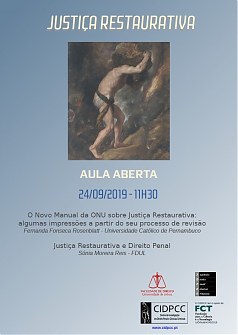
CIDPCC organizes an open lecture on September 24th, from 11:30am to 1pm.
Investigators Fernanda Fonseca Rosenblatt (Universidade Católico de Pernambuco) and Sónia Moreira Reis (Lisbon University School of Law) will lecture on the new UNO Handbook on Restorative justice programmes, and on restorative justice and criminal law, respectively.
Congratulations to our researcher Wagner Marteleto Filho, who received his PhD at the University of Lisbon by September 17th.
Wagner Marteleto Filho successfully defended his PhD thesis entitled “O problema do desconhecimento no dolo: os dois planos de normativização do elemento intelectual, com particular aplicação ao erro e aos desvios dos processos causais”, having obtained the classification Very Good, with distinction and praise.
We wish him the best of luck in his future endeavours!
The Research Centre for Criminal Law and Criminal Sciences participated, represented by Professors Maria Fernanda Palma and Helena Morão, participated at the authors’ conference of the Day Fine Project organized by the Erasmus School of Law

The Institute / Center for Research in Criminal Law and Criminal Sciences offers its congratulations to researcher Prof. Maria do Céu Soares Machado on her academic jubilee, on June 4th at the Faculty of Medicine of Lisbon University, and wishes all the best for her future projects
The workshop is organized by CIDPCC, in partnership with CEDPAL-Göttingen and USP-São Paulo, and will take place on April 15-16, 2019, in the FDUL- School of Law of Lisbon University.
The workshop is restricted to discussion only among invited speakers, in the presence of the audience, while the public session consists of guest interventions and is open to public discussion.
Registration will be limited to the venue’s capacity.
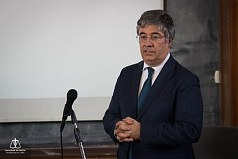
On April 4, between 5:00 pm and 7:00 pm, a conference will be held by Prof. Dr. Nuno Nabais (School of Arts and Humanities of the University of Lisbon), on the topic “Right to Truth. Is it possible to define knowledge outside legal models”.
The conference will be held in Portuguese language.
Abstract. Contemporary philosophy is marked by the multiplication of theories of truth. Many of these are effects of new domains of knowledge such as neuroscience and AI. Others bring to the ultimate consequences the essentialist metaphysics and the semantics of possible worlds. Our question is: to what extent do models emerging in the juridical thought of the 20th century help to understand some of the new theories of truth in contemporary philosophy?